The Algerian constitution is based on Islamic religion. The Art 2 said that [Islam is the religion of the state]. The Art 3 [Arabic is the national and official language]. Art 9 [The institutions are not allowed:
- feudal, regionalist and nepotic practices;
- setting up exploitation relationships and dependence links;
- practices that are contrary to the Islamic ethics and to the values of the November revolution].
Also the Algerian President takes the Oath according to Art 76 in the following terms:
[” In the Name of God the Merciful and the Compassionate. Faithful to the great sacrifices and to the memory of our martyrs as well as to the ideals of the eternal November Revolution. I do solemnly swear by God the almighty that I will respect and glorify the Islamic religion…”.
We can also observe the influence of Islam on Algerian constitution in Art 171 [A High Islamic Council is instituted to the President of the Republic and is trusted, in particular, with :
- Encouraging and promoting”Ijtihad";
- Expressing its views in comparison with religious precepts on matters submitted to it;
- Presenting a periodic report of activity to the President of the Republic].
This is what could I reproducing from reading Algerian constitution, maybe there are others articles on, which have relationship with Islamic religion, if you need a free copy (English or Arabic version) of the Algeria's constitution, feel free to post a comment and I will give you one.
Have a nice day.
Algerian Money -in circulating-
These coins are currently circulating in Algeria as money.

The monetary system of Algeria is single-unit based, with the unit of Algerian money being called the Dinar. The names and relative values of the coins depicted above are, from left to right:
One Dinar - (1 Dinar)
Two Dinars - (2 Dinars)
Five Dinars - (5 Dinars)
Ten Dinars - (10 Dinars)
Twenty Dinars - (20 Dinars)
Fifty Dinars - (50 Dinars)
One Hundred Dinars - (100 Dinars)
Please note that this listing only includes the coins in circulation. There will be paper money circulating as well.
Money of Algeria from About.com



Algerian money -image-
Money List of Algeria from 1944 until now. See pictures below;


P-135 Algeria 1983 Two Hundred Dinars Unc

And this last is still using until today.
P-99a Algeria 1944 Two Francs Unc
P-126a Algeria 1970 Five Dinars Unc
P-127a Algeria 1970 Ten Dinars AU
P-127a Algeria 1970 Ten Dinars Unc

P-130 Algeria 1977 Fifty Dinars Unc
P-132a Algeria 1983 Ten Dinars Unc
P-135 Algeria 1983 Two Hundred Dinars Unc
And this last is still using until today.
Pictures from en.18dao.net/Money_Image/Algeria
Want to work in algeria -find jobs-
Are you looking for a job in Algeria, so, you can start search your job using those websites;
Emploinet
Emploialgerie
Dz-recrute
Pharmarecrute-algerie
Interprofils recruitment solutions
Emploi-dz
Ingdz
Emploitic You can also visit the forum
Algeriarec
If I found others website I will update the list and if you knew one, feel free to post it here, I will be verry happy.
Good luck.
Emploinet
Emploialgerie
Dz-recrute
Pharmarecrute-algerie
Interprofils recruitment solutions
Emploi-dz
Ingdz
Emploitic You can also visit the forum
Algeriarec
If I found others website I will update the list and if you knew one, feel free to post it here, I will be verry happy.
Good luck.
Just in Algeria
In Algeria all is possible...
In Algeria there's no impossible...
You ask me WHY ? So, see this video;
Now you understand why i said that "in Algeria all is possible".
Have a nice day.
In Algeria there's no impossible...
You ask me WHY ? So, see this video;
Now you understand why i said that "in Algeria all is possible".
Have a nice day.
El Penon - The Spanish period

In 1510, after Bejaïa was conquered by the Spaniards, Algiers became dependent on catholic Spain. To escape destruction, the city authorities abandoned one of the islands facing the city to Spain (El Peñon de Argel). It is D. Diego de Vera, commander of the Mediterranean sea fleet which was in charge of occupying an building a fortress on the small island of the Beni-Mezrena Medina.
It is thus with the "assent" of Algiers inhabitants that supplied the necessary materials and worked even with the Spanish soldiers that this castle was built. Forced, in 1511, El-Djazaïr signed a treaty recognizing the autonomy of the Penon. The loss of the authority of the city on the Penon was then felt in a rough way.
After Ferdinand the Catholic died in 1516, the king of Algiers tried to escape a treaty engaging him to pay an annual tax to Spain ; Selim Etteumi appealed to the Ottoman-Greek pirate Arudj (Arroudj) Barbarossa to dislodge them. After numerous attempts of reconquest, Arroudj gave up the power. His brother Khayr al-Din took over him and thirteen years later in 1529 he destroyed the Penon after a strong attack.
The Peñon fortress was completely destroyed with the the exception of two towers. A part of the Spanish occupants was killed and the other took as slaves.
Christians were then enlisted to take charge with filling the channel separating the island from the continent. A Mole of 200 meters long, 25 meters wide and 4 meters high was built. The mole marked then the beginning of the naval base of the Regency.
In 1541, under the government of Hassan Pacha a tower, which shelters the current lighthouse, was built on the ruins of El Penon. The mole will then experience numerous modifications during the Ottoman and French occupation to become what is called today the Admiralty. Its shelters nowadays barracks of the navy.
The cave of Miguel de Cervantes

One of the historical spots that the Medina offers since the 16th century is the cave of the prestigious Spanish writer Miguel de Cervantes (1547-1616), author of the immortal novel "Don Quixote de la Mancha", edited in 1605.
This cave is always accessible situated in the district of Belouizdad (Algiers) where it is nestled in a hollow of the cliff overlooking the beach in the Bay of Algiers.
The restoration of this natural and historical spot were recently achieved with the sponsorship of the Spanish company Repsol. This place that inspired the writer in his writings is made up of 4 distinct parts: the cave, preserved in a state close to its origin, the shelter, the balcony with a splendid view over the bay of Algiers and the esplanade. This place was built in the past to ease the cave access. In the middle is erected, thanks to the Spanish community Algiers, a stele since 1887 in memory of the captive of Algiers.

(Picture : Fellous Amina)
Miguel de Cervantes spent five years in Algiers after being captured by the flotilla commanded by the Ottoman Mamí Arnaut (meaning Mami the Albanian) on Sept. 26, 1575 while he was returning to the Spain on the galley Sol after his stay in Naples. Cervantes is assigned with his brother Rodrigo as a slave to the Greek Dali Mamí. Finding in his possession letters of recommendations written by the Don Juan of Austria and the Duke of Sessa led his jailers to think that Cervantes was very important and that they could get a good ransom. The price for his release was set at Five hundred gold Ecu. During a second attempt to escape, Cervantes and his companions had to hide in the cave waiting for a Spanish galley that would come on the beach in Algiers. The galley who tried to approach twice the beach was taken by the guards of the king of Algiers Hassan Pasha. Discovered Cervantes was then put under surveillance.
Back in his country after his liberty was bought by the Trinitarian Juan Gil in 1580, Cervantes put then all his efforts in writing until his death in 1616.
Oran in Algeria
Explore the wonders of Oran
Oran is perhaps most famous for being one of the birthplaces of the Ra music style. This inventive music form is one of the more modern music forms popularly enjoyed in the various parts of Algeria and all over the world. The easy going and liberal atmosphere that pervades the city of Oran is clearly evident in the music style. Initially performed only by men, it soon became the domain of many women - many of whom have become every bit as popular as their male counterparts.
Founded by Moorish Andalusian traders around AD 937, the city has been around a long time. Due to its position on the coast, it quickly developed into a city with a thriving trade industry and developed strong business ties with Spain. Unfortunately it wasn't too long before the Spanish took occupation of Oran. This soon changed when invading Ottoman forces captured the city but the Spanish rose to reclaim the city two years later, only to abandon it when it suffered from an earthquake in 1790. Much of the development and progress evident in Oran today is largely due to the French who eventually occupied the city in the 19th century.
Oran is a lot larger than many think. The second largest city in Algeria, it is an industrial, cultural and educational centre for the country. Though part of it is covered by high-rise apartment buildings and fairly unattractive homes, there are older parts which make for interesting sight seeing. The Great Mosque built in 1769 is a good place to start. It is open to the public which is quite unusual in this part of the world. The Marabout Sidi Mohammed El Haouri is a very good example of Andalusian architecture. For all things historical, the Demaegth Museum has exhibitions which span thousands of years. The Cathedral de Sacre Coeur is a beautiful old building which has been converted into a public library.
Though Oran is a costal town, the beaches in the immediate vicinity of the city are not terribly good. However a short trip away from the hustle and bustle will leave you with miles of beautiful sand and refreshing sea water. It may be a bit out of the way, but Oran is a great place to visit while traveling Algeria.
Oran is perhaps most famous for being one of the birthplaces of the Ra music style. This inventive music form is one of the more modern music forms popularly enjoyed in the various parts of Algeria and all over the world. The easy going and liberal atmosphere that pervades the city of Oran is clearly evident in the music style. Initially performed only by men, it soon became the domain of many women - many of whom have become every bit as popular as their male counterparts.
Founded by Moorish Andalusian traders around AD 937, the city has been around a long time. Due to its position on the coast, it quickly developed into a city with a thriving trade industry and developed strong business ties with Spain. Unfortunately it wasn't too long before the Spanish took occupation of Oran. This soon changed when invading Ottoman forces captured the city but the Spanish rose to reclaim the city two years later, only to abandon it when it suffered from an earthquake in 1790. Much of the development and progress evident in Oran today is largely due to the French who eventually occupied the city in the 19th century.
Oran is a lot larger than many think. The second largest city in Algeria, it is an industrial, cultural and educational centre for the country. Though part of it is covered by high-rise apartment buildings and fairly unattractive homes, there are older parts which make for interesting sight seeing. The Great Mosque built in 1769 is a good place to start. It is open to the public which is quite unusual in this part of the world. The Marabout Sidi Mohammed El Haouri is a very good example of Andalusian architecture. For all things historical, the Demaegth Museum has exhibitions which span thousands of years. The Cathedral de Sacre Coeur is a beautiful old building which has been converted into a public library.
Though Oran is a costal town, the beaches in the immediate vicinity of the city are not terribly good. However a short trip away from the hustle and bustle will leave you with miles of beautiful sand and refreshing sea water. It may be a bit out of the way, but Oran is a great place to visit while traveling Algeria.
Explore the wonders of Oran from Algeria.com
The Geography of Algeria
The Geography of Algeria from algeria.com
Algeria holds the title of Africa's second largest country and the tenth largest in the world. Covering such an immense landscape, Algeria is a country of diversity, extending from coastline to the Sahara desert. Algeria's geography is fascinating and traveling through the country is a unique experience. Join us as we consider Algeria's geographical features.
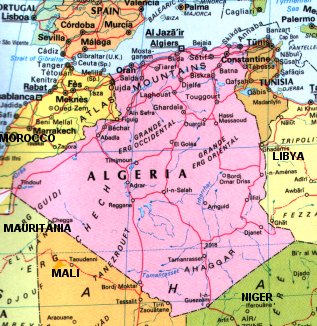
Situated in North Africa, Algeria is bordered by the Mediterranean Sea in the north, Tunisia and Libya toward the east, Mauritania, Niger and Mali in the south, and Morocco on the west. Algeria's climatic regions and landscape can be divided into four sections which run parallel to each other horizontally down the country. The northern-most division, the Tell, takes in all of the 1 200km of Algeria's coastline. It is described as a hilly sub-coastal zone and forms a small percentage of Algeria's land area. Despite its small size, the Tell is inhabited by more than ninety percent of Algeria's population, chiefly because it is the most fertile region. Major cities, including the capital Algiers are scattered along or near the coastline.
South of this section you will come across the Tell Atlas mountain ranges with its impressive peaks and lovely valleys. The mountain ranges extend into the High Plateaus, a massive area of mostly barren plains. The next landscape band is made up of further mountain ranges which are part of Algeria's Saharan Atlas range.
The last section, and the biggest is the Sahara desert. This expanse covers over 80 percent of Algeria's land area to the south of the Saharan Atlas range. An area of extremes, the Sahara desert is certainly not dull, but rather a place where you will observe the most striking sights.
Algeria's territory can be described as arid to semiarid. Rainfall in the northern areas of Algeria measures around 1 000mm annually. The coastal areas experience mild, wet winters and hot, dry summers. Certain sections of the Sahara desert may not receive rain for periods of up to 20 years. Temperatures in the Sahara can push the mercury past 55'C. During Algeria's summers a hot Sirocco wind blows bringing with it dust and sand.
Natural resources in Algeria include petroleum, iron ore, uranium, zinc, lead, natural gas and uranium. Algeria's chief crops grown in the more fertile regions are sorghum, barley, maize, wheat and oats. Vineyards as well as tobacco plantations in the country export their products. Other goods grown are dates, figs, fruits, olives and vegetables. Algeria also exports large quantities of cork.
From the relatively fertile, mountainous areas of the north to the expansive Sahara desert to the south, Algeria's geography is diverse and a real treat to the eyes.
El-Jenina or Dar Es´soltan el kedima

This berbre Fort which was the residence of the King of the Thaaliba tribe and King of the Mitidja Selim ETTEUMI (Toumi), owes its name to a small garden placed in its northern side. This palace was built near the center of the Medina.
When the Turks took the power in Algiers in the beginning of the XVI century, Baba Arroudj who became king of the city settled down in this Palace. Place of governance of El-djazair, its first restorations were made between 1552 and 1556 under Salah Raïs Ben Djaafar era.
This State residence was Ali Khodja´s Government hall until 1817; main acts of regency took place there ex. judgements of political crimes ; The Jenina held Diwan meetigs as well as those of algier´s consuls ; Yeni Ceri ( Janissairs) perceived their salary there.
On November, 1st, 1817 Ali Khodja transfered the power place to the Citadel of the Casbah. This foritfied building was placed at the top of the triangle which formed then the city to El-djazair. El-Jenina will then be called by the population Dar El soltane el kadima (Former house of the Sultan) In 1830, the French occupied it and installed the clock of the city there. The Jenina served then as accommodation center for the army.
In 1844, a devastating fire destoyed a part of the building. Regrettably twelve years later, in 1856, the colonial authorities destoyed the anciant palace to replace it by recent buildings. A street of the low Kasbah will be called after this lost palace.
Subscribe to:
Posts (Atom)